


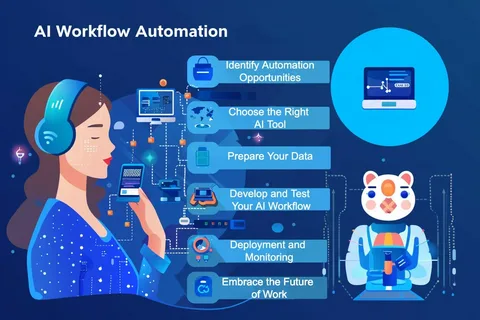
In the fast-evolving landscape of digital business, accuracy, efficiency, and reliability are essential for outperforming competitors and satisfying customers. Manual, repetitive workflows have long been the source of countless human errors—errors that can damage reputation, increase costs, and result in lost opportunities. With the advent of AI workflow automation, organizations now have the power to reduce manual errors dramatically, streamlining operations and unlocking newfound productivity.
Let’s dive deep into understanding how AI workflow automation reduces manual errors, and why every modern enterprise should embrace this technology to secure a competitive edge.
The Costs of Manual Errors in Traditional Workflows
Before exploring the power of AI, it’s crucial to understand the scope of the problem. Manual errors often creep in because of fatigue, distraction, or a lapse in concentration. In high-volume, complex processes such as data entry, reporting, scheduling, and compliance checks, even a tiny oversight can cascade through systems, resulting in:
- Financial losses
- Decreased customer satisfaction
- Operational inefficiencies
- Compliance risks
Many organizations have dedicated substantial resources to fixing these errors—resources that could otherwise fuel innovation. Clearly, a transformative solution is needed.
Revolutionizing Processes: How AI Workflow Automation Works
AI workflow automation leverages intelligent algorithms and machine learning to automate complex workflows that would otherwise require tedious manual intervention. By minimizing human input at each stage and harnessing the unique strengths of artificial intelligence, organizations can dramatically lower the chances of error while accelerating processes.
Here’s an in-depth look at the core ways AI workflow automation reduces manual errors:
1. Reduced Human Intervention
The cornerstone of error reduction in AI workflow automation lies in eliminating repetitive and error-prone manual tasks. By automating data entry, document processing, and decision routing, AI minimizes the opportunities for mistakes associated with human fatigue, multitasking, or simple oversight. This approach not only decreases the error rate, but also refocuses human talent on more strategic, value-driven work.
Learn more about enterprise-level AI solutions at enterprise ai platform.
2. Consistent Execution
Humans, by nature, bring variability to their work. Even the most skilled employees can interpret workflow steps differently or bypass certain process checks when under pressure. In contrast, AI-powered automation adheres to strict rules and algorithms, ensuring each task is completed exactly the same way every time. This unwavering consistency eliminates ambiguity and guarantees compliance with standard operating procedures—one of the most reliable ways to prevent errors from inconsistent application of processes.
3. Real-Time Error Detection and Correction
One of the standout features of AI workflow automation is its capacity for real-time monitoring. AI systems are programmed to spot anomalies, inconsistencies, or deviations the moment they occur—whether it’s an out-of-sequence action, inaccurate data entry, or a missed approval. Upon detection, the system can instantly correct the error or escalate it for human review, stopping issues before they multiply.
For more insights into how AI agents manage workflows and error detection, explore what is an ai agent.
4. Improved Data Accuracy Through Intelligent Validation
Data is the lifeblood of modern enterprises, but its accuracy can be compromised through manual management. AI-powered validation tools verify, cleanse, and auto-correct incoming data in real-time. They cross-reference entries, flag discrepancies, and update records automatically, maintaining database integrity for industries like finance, healthcare, and manufacturing—where data errors can be especially costly.
5. Enhanced Decision-Making
AI algorithms can process vast amounts of structured and unstructured data at speeds no human could match, extracting insights and patterns that even experts might miss. Armed with accurate, real-time information, businesses can make well-informed, evidence-based decisions, greatly reducing errors caused by flawed judgment or outdated data.
6. Streamlined and Optimized Processes
Bottlenecks, duplicative tasks, and poorly coordinated handoffs plague manual workflows, causing confusion and preventable errors. AI workflow automation streamlines these processes: it automates repetitive steps, smooths out transitions, and dynamically allocates resources, turning complex procedures into straightforward, error-resistant workflows.
To see how tailored AI solutions can supercharge your operations, review the capabilities of an enterprise ai agent.
7. Continuous Learning and Improvement
AI systems are never static; they continuously learn from every task and outcome. Through machine learning, these systems analyze past mistakes, recognize new error patterns, and adapt their rules accordingly. This ongoing refinement creates a feedback loop, making workflows smarter and more accurate over time—something manual processes cannot achieve at scale.
Industry Use Cases: Real-World Proof of Impact
Finance: Automated compliance checks detect missing documentation or irregular transactions instantly, cutting financial losses and audit risks.
Healthcare: AI validates insurance claims and patient data, reducing claim denials caused by incorrect or incomplete information.
Manufacturing: Automated quality control catches product defects on the production line before they reach customers, maintaining brand integrity.
Retail: AI-driven inventory tracking and ordering minimize stockouts and overstocking, enhancing accuracy in supply chain management.
Future-Proofing Your Business with AI Workflow Automation
The journey from manual to automated processes is no longer optional—it’s a necessity for organizations that want to avoid costly errors, stay compliant, and meet customer expectations with speed and precision. Adopting AI workflow automation isn’t just about slashing error rates; it’s about empowering teams, creating new value, and future-proofing operations as markets get more competitive and digital transformation accelerates.
Frequently Asked Questions (FAQ)
1. What is AI workflow automation?
AI workflow automation refers to the use of artificial intelligence and machine learning to execute complex business processes without human intervention, minimizing errors and improving efficiency.
2. How can AI reduce human errors in the workplace?
AI reduces human errors by automating repetitive tasks, ensuring consistency, and providing real-time monitoring and correction of mistakes.
3. Is AI workflow automation suitable for small businesses?
Yes, AI workflow automation can be scaled for small businesses, providing error reduction benefits and freeing staff for core activities.
4. What types of tasks are best suited for AI automation?
Tasks that are repetitive, rule-based, or require consistent accuracy—such as data entry, reporting, compliance, and approval workflows—are ideal for AI automation.
5. Will AI completely eliminate manual errors?
While AI significantly reduces manual errors, some human oversight is still required for exceptions, creative tasks, and strategy.
6. How does AI detect and correct errors in real-time?
AI monitors workflows for anomalies and deviations, automatically correcting them or raising alerts for human intervention.
7. Can AI workflow automation adapt to changing processes?
Yes, AI systems featuring machine learning continuously learn and adapt as processes evolve, ensuring ongoing accuracy.
8. Is data security a concern in AI automation?
Reputable AI solutions adhere to strict security protocols and compliance standards, protecting sensitive data processed through automated workflows.
9. How long does it take to implement AI workflow automation?
Implementation time varies, but many providers offer rapid-deployment solutions that can be up and running in weeks.
10. What are the first steps to introducing AI workflow automation in my organization?
Start by auditing current processes for error-prone tasks, consult with an AI specialist to identify suitable areas for automation, and pilot solutions with clear metrics for success.
Unlock the Power of Error-Free Operations
The future belongs to businesses that embrace transformative technologies. With AI workflow automation, organizations can leave behind the limitations of manual processes, ensuring accuracy, speeding up operations, and unlocking powerful new growth opportunities. By minimizing manual errors, you invest in credibility, customer satisfaction, and true operational excellence—cornerstones of long-term success.
